


More and more Germans

In 2003, the German ‘Agenda 2010’ institutionalised the ‘Supply-side economics’ approach (reduction of the Welfare State, liberalisation of the labour, tax, financial and banking systems, etc). Unemployment soared in 2005, and ever since it’s been decreasing to present 5.4% what is below the averaged 6% but far from the record low of 0.40 % in June of 1962. 1

The ‘mini jobs’ and ‘micro jobs’ created in Germany since 2003 have helped to fulfill the econometric prophesies but are of such a poor quality that Net Real Wages have been decreasing. 2
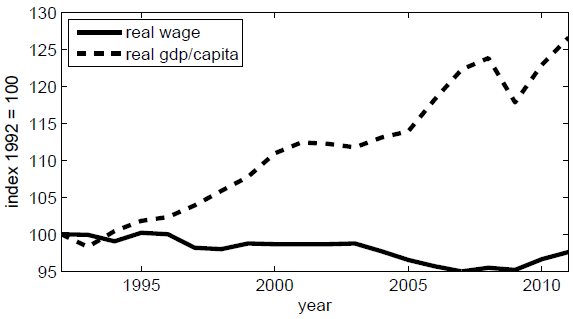
During the same period, Germans achieved the highest level of education of any group of workers in Europe. 3
Economic growth has been very strong, but nullified by rising inequality levels. Today, more than 16% of Germans are living below the poverty line (It has duplicated since 2000) 4, being the children in the big cities the more heavily hit. 5
.

More and more well educated Germans are working, they work more and more hours to get less money and, even though they are paying enough taxes to support a sustainable welfare system, they are becoming poorer and poorer while some Germans are becoming extremely rich. I must admit, this final statement is highly debatable but I consider proven that attaining higher levels of education does not necessarily make you a wiser Nation. _________________ 1. Supply-sided economists would argue that ‘adequate levels of unemployment are even desirable to keep wages low’, to which I’d like to add a caveat: If and only if, you are not unemployed. Officially 2,5 million persons in Germany, 6 million personas in Spain, and so forth.
3. http://countrystud…s/germany/143.htm

Comments